Market reads
Japanese vs English Pokemon Cards: How Values Differ
Japanese vs English Pokemon cards: how releases, exclusives, condition and grading differ, and how to compare values for the same card in both languages.
Japanese and English Pokemon cards are two related markets with their own release calendars, set structures and exclusive promos. Whether a Japanese copy or its English counterpart is worth more varies card by card, so the habit that actually helps is matching the exact print, language, condition and grade before you compare anything.
Quick summary
- Release timing and set contents can differ; verify the particular product in each language.
- Some promos and treatments are specific to a release or region; check the exact card.
- Text, set identifiers and artwork can differ across releases; inspect the actual copy for condition.
- Grading services grade both languages, and the same number from two different services is not automatically the same standard.
- Values move independently. A reprint, a new set or a wave of grading submissions can shift one language before the other.
Why do collectors talk about Japanese print quality?
Do not infer condition from the language on the card. Inspect the physical copy for centering, corners, edges and surface wear, and check the finish against the exact release. A broad reputation for print quality does not establish the grade or value of an individual card.
The practical version of this is simple: judge the copy, not the language. Work through the same checklist for a Japanese card and an English card.
- Centering: inspect both the front and back instead of judging one side only.
- Corners: look for softening or fraying under angled light rather than straight on.
- Edges: whitening shows up fastest along the borders of dark-bordered cards.
- Surface: tilt the card to catch print lines, dimples, scratches and handling gloss.
- Holo pattern: check for scratching across the foil, which is easy to miss in a sleeve.
Raw marketplace condition labels such as Near Mint, Lightly Played, Moderately Played, Heavily Played and Damaged describe observed wear under a marketplace standard. They are not automatic equivalents of a professional numeric grade. If you want the longer version of that, see the condition guide linked at the end.
Do Japanese and English sets actually have different cards?
Japanese and English releases do not always map one to one. Check the official card list and product information for the specific expansion or promo rather than assuming the same artwork has the same set identity or collector number in both languages.
- Release dates: consult the official schedule for the product and language you want.
- Promos: confirm the campaign, release and language associated with the exact card.
- Set structure: because Japanese sets can be merged or reshuffled into a larger English set, the cards that appear together, and the set symbol you should be matching, differ between versions.
- Reprint timing: a card can go years without a reprint in one language while the other language gets one, which changes what each version is trading for.
None of this makes one region's card list more complete. It does mean a set collector chasing a full binder usually picks a language and stays with it, because mixing versions makes completion targets and price checks harder to keep straight.
How do you compare demand without guessing?
A buyer can prefer a language, artwork or particular release for many reasons. Instead of ranking demand for an entire language, compare transactions for the exact cards you are considering.
- Look at recent sold prices, not asking prices. Listings are aspirational and can sit unsold for months on cards that trade rarely.
- Compare like with like: a Japanese Near Mint raw copy against an English Near Mint raw copy, or one graded copy against another graded copy at the same grade from the same service.
- Check how many copies are actually changing hands. A single high sale on a thin market is a data point, not a price.
- If using grading population reports, remember they count recorded submissions, not all surviving copies or current buyer demand.
Raw versus graded across the two languages
Compare raw and graded copies separately for each language. A high grade can carry a premium, but neither the premium nor the net result after fees is guaranteed. Grading services apply their own standards and judgment; a raw condition label is not an assigned numeric grade.
Here is a hypothetical to show how the arithmetic works. The numbers are assumptions for illustration, not quoted prices or fees.
- Assumption: you buy a raw Near Mint copy for $40.
- Assumption: grading plus shipping both ways costs $35, so you are $75 in.
- Assumption: if it returns at the top grade you sell for $150, pay a combined 13 percent in marketplace and payment fees ($19.50) and $5 to ship, netting $125.50 for a $50.50 difference.
- Assumption: if it returns lower and sells for $60, fees of $7.80 and $5 shipping leave $47.20, which is $27.80 less than you put in.
- The takeaway: the downside case is what decides whether a submission makes sense, and grading service levels carry insured-value limits, so check current service options, turnaround and fee terms before you commit.
| What to check | Japanese release | English release |
|---|---|---|
| Release timing | Japanese releaseCheck the official product schedule. | English releaseCheck the official product schedule. |
| Set structure | Japanese releaseOne English expansion can correspond to more than one Japanese set | English releaseA single set can gather cards from multiple Japanese sets |
| Exclusives | Japanese releasePromos tied to Japanese magazines, campaigns and events | English releasePromos tied to organized play, retail and movie tie-ins |
| Card markings | Japanese releaseJapanese text, region-specific set symbols and copyright lines | English releaseEnglish text, different set symbols and rarity marks |
| Condition | Japanese releaseInspect centering, corners, edges and surface on the actual copy | English releaseSame checklist, judged on the copy in front of you |
| Value check | Japanese releaseMatch language, set, printing, condition and grade before comparing | English releaseSame, and keep raw and graded comps separate |
Should you collect one language or track both?
Choose a primary language if that makes your set-completion goal clearer, or track both when you enjoy the different releases. Keep separate targets and exact-printing records. A lower price in one language does not imply an opportunity to profit because demand and selling costs can differ too.
That is mostly a record-keeping problem. Nobody holds current pricing for two entire card markets in their head, and a static guide ages quickly on actively traded cards. Brickify's Pokemon catalogue includes English and Japanese options with search, so you can pull up the same character in either language, choose the specific printing rather than guessing, and see estimated values with separate raw and PSA 10 selectors alongside Near Mint through Damaged condition estimates. Estimates are a reference, not guaranteed sale prices or a professional appraisal.
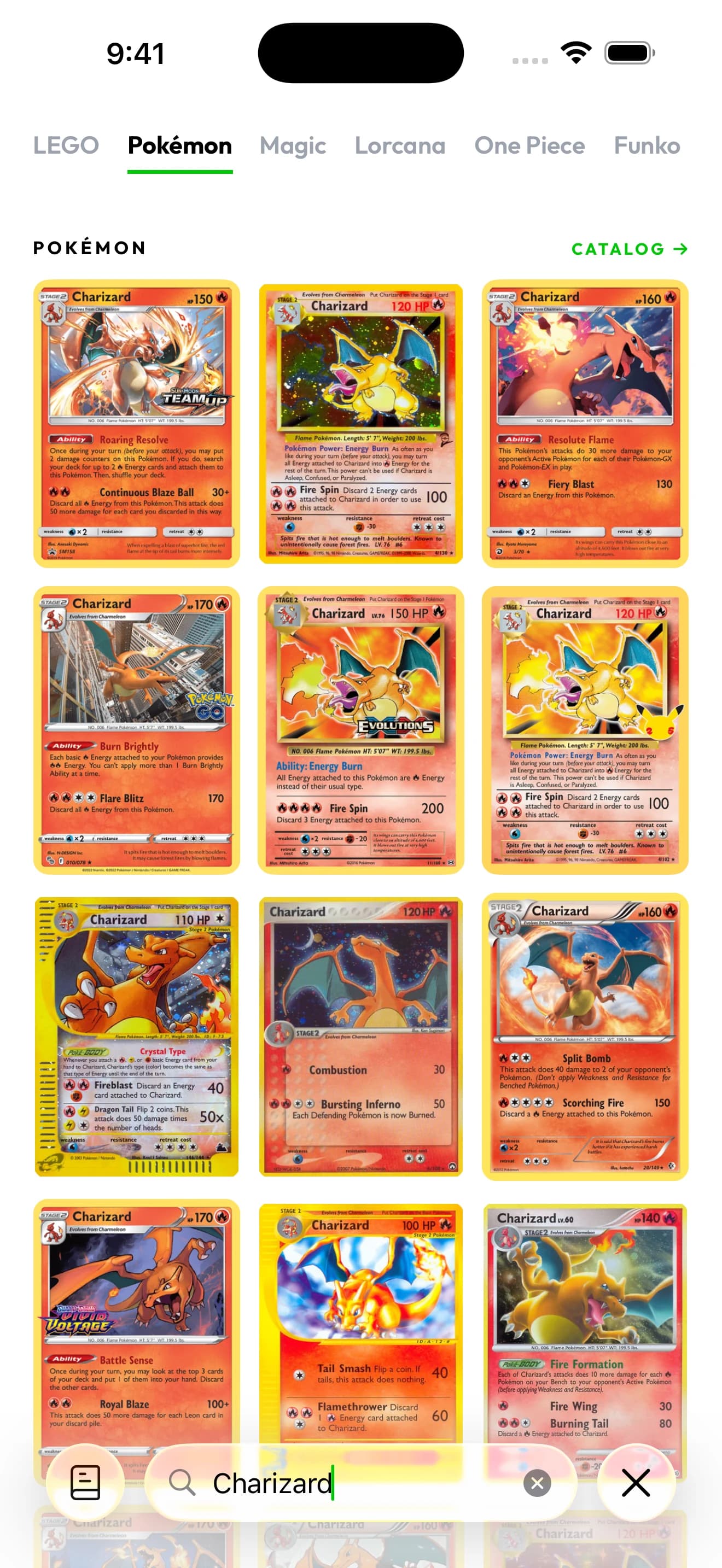
Search results put different Charizard printings side by side. Match the artwork, set and collector number before saving a card.
Captured in Brickify on iPhone 17 Pro Max. View full-size screenshot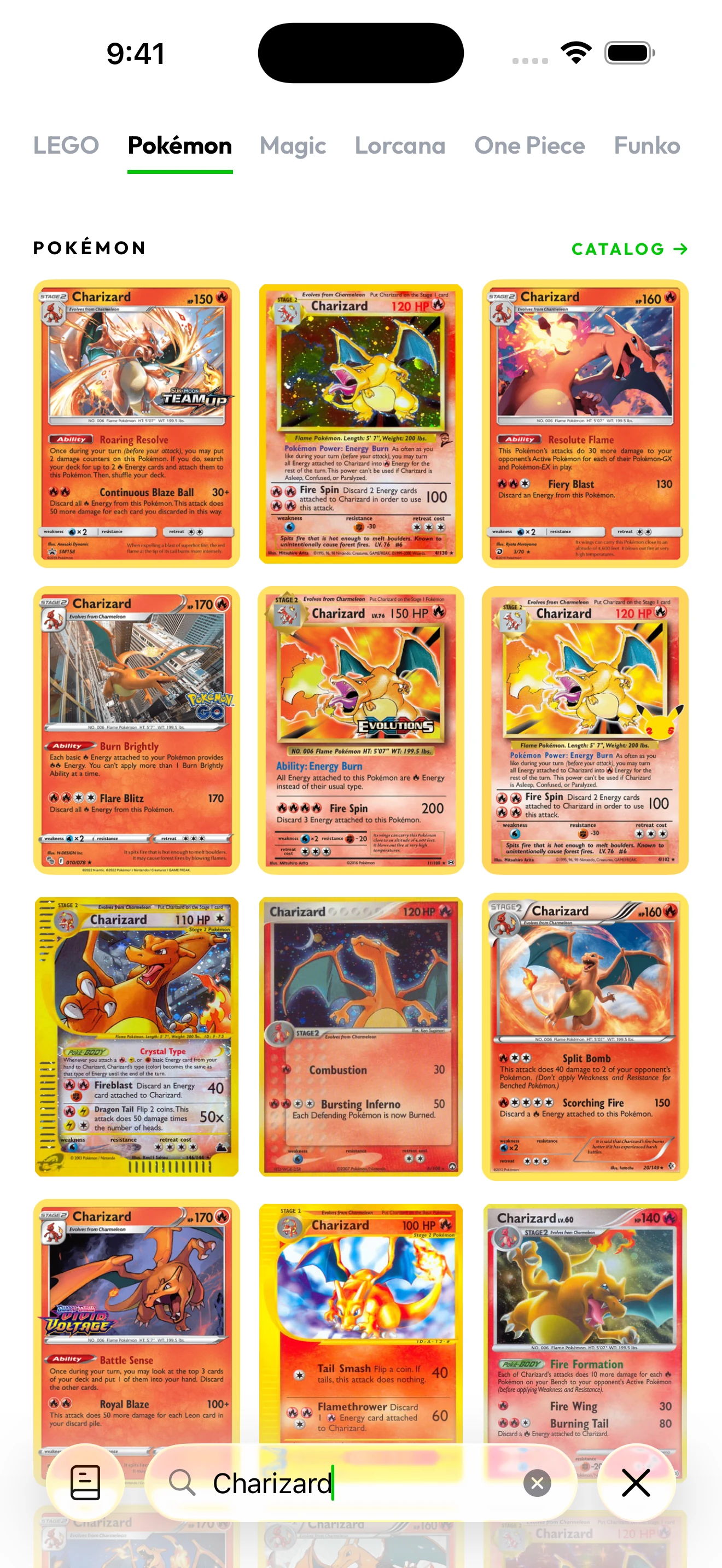
How do you spot a real gap between the two markets?
By comparing recent sold prices for the same character, printing and rarity across both languages side by side, not by comparing list prices or a memory of what a card used to fetch.
- Match rarity and condition first, raw against raw and graded against graded at the same grade and service.
- Check how recent the comps are. A reprint announcement, a tournament result or a show appearance can distort prices for weeks.
- Watch population trends over time rather than a single figure, since a submission wave can change the picture.
- Include your own costs: shipping, marketplace and payment fees, and import charges if you are buying from another region.
- Note the currency you are reading. A gap that looks real can partly be an exchange-rate artifact.
If you are working through a binder page or a stack of recent pulls, Brickify includes bulk scanning modes for trading cards. Separate the cards, use even lighting, and review each match and variant before saving it so that language and printing are recorded correctly.
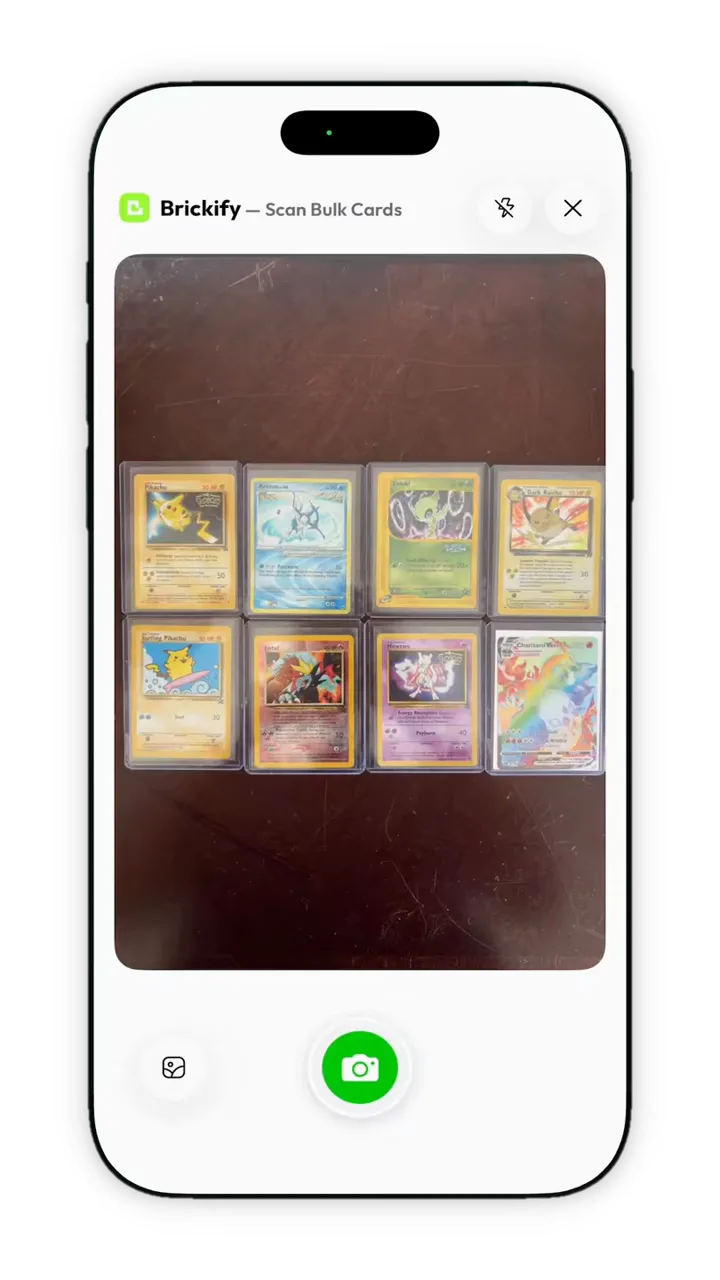
Eight cards are visible in this bulk camera view. Leave identifying details exposed, then review each returned match.
From a Brickify app recording. View full-size screenshot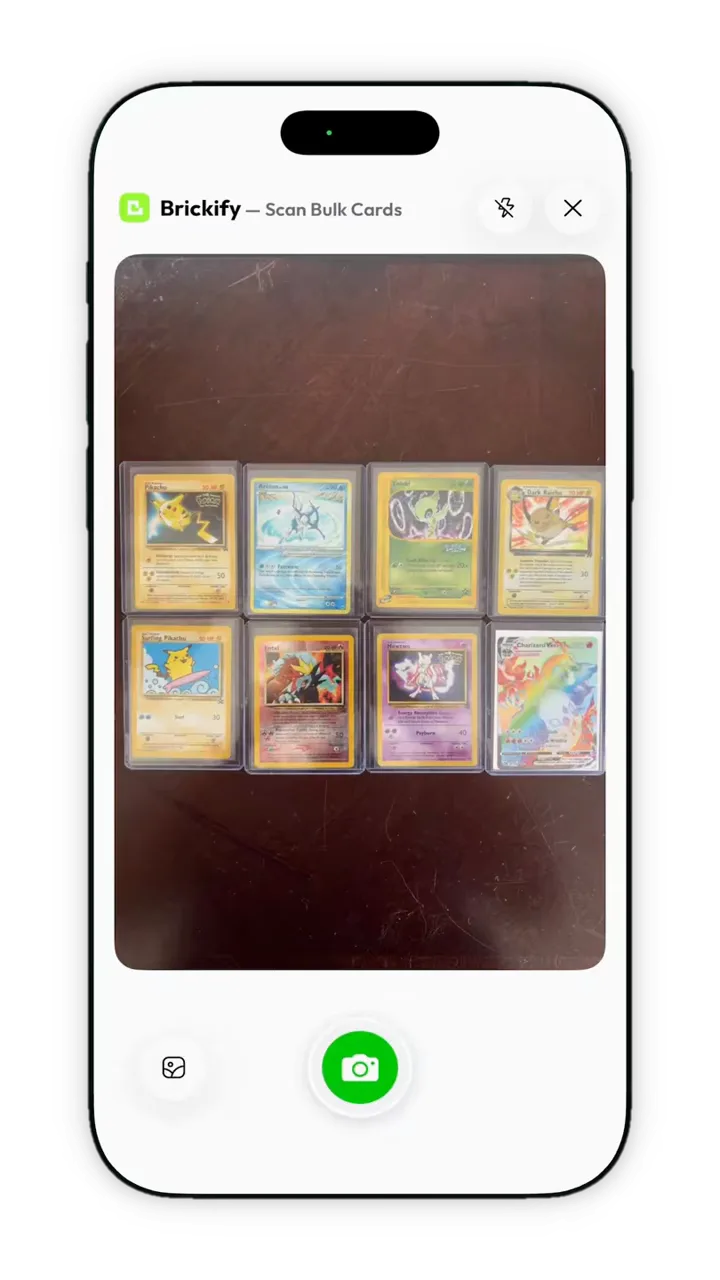
Does the gap between markets change over time?
Price relationships can change. Compare the same versions and condition at dated intervals, and keep currency, shipping and any import costs consistent. A visible difference is not by itself an arbitrage opportunity or prediction of the next move.
Trend direction over time tells you more than a single price point. In Brickify you can keep cards in binders, record quantities, condition and purchase details, and follow your collection's estimated value history, with the same account across supported devices. If you hold both Japanese and English copies of the same characters, that history makes it easier to see which side of the collection has been moving.
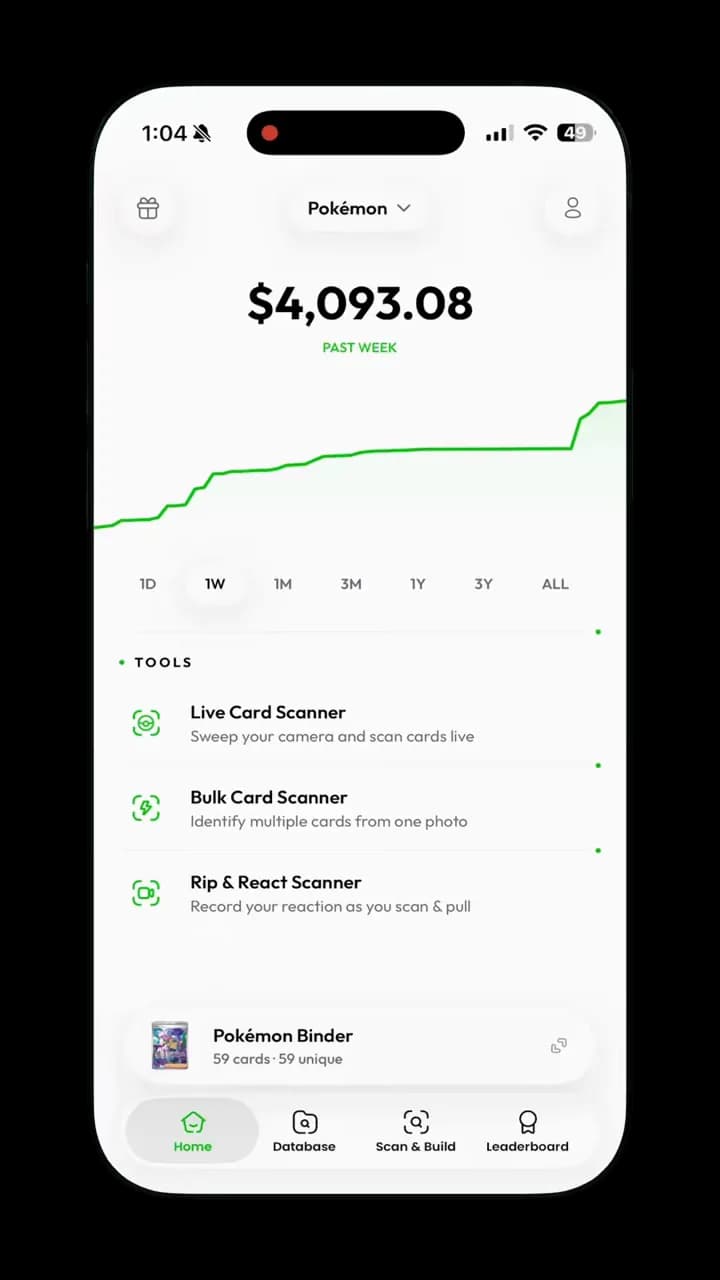
A Pokémon collection overview brings the binder and its value history together. Keep the cards and quantities in the app aligned with the cards you own.
From a Brickify app recording. Displayed values are examples from the capture, not current quotes.View full-size screenshot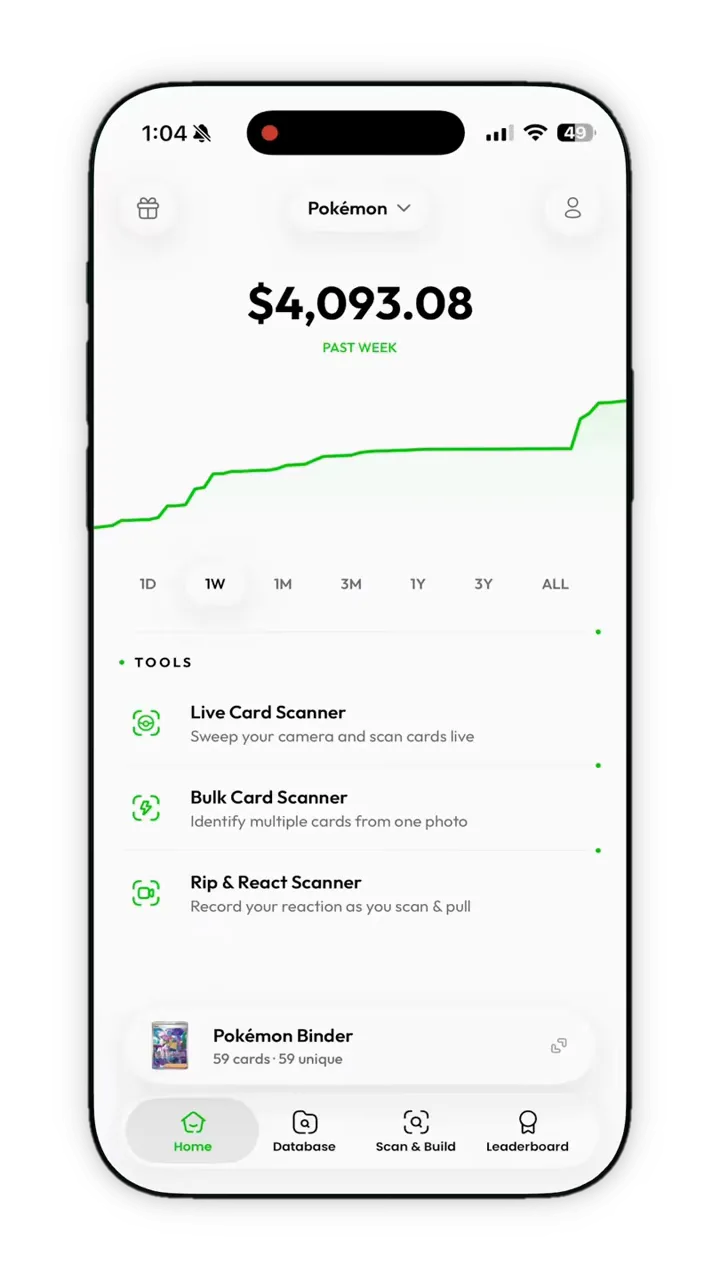
Keep reading
- What condition means for a card's value
- Raw versus PSA graded prices, and how to read the spread
- PSA, CGC and BGS: how the services differ
- Is your card worth grading?
- Live market prices versus printed price guides
- Understanding collectible price changes
- Vintage Pokemon card values, set by set
- Scan and price Pokemon cards with Brickify
The short version: Japanese and English Pokemon cards are two related markets with different calendars, different exclusives and their own buyer pools. Neither is automatically the smarter buy, so match the exact card and check current comps on both sides before you spend.
The app for your collection
Put your Pokémon collection in focus.
Scan your cards, check their estimated value, and keep your collection together with Brickify.
Free to download · iPhone, iPad & Android
Explore the Pokémon scannerEstimates are a reference, not guaranteed sale prices. Brickify is independent of the owners of the collectible brands mentioned here.